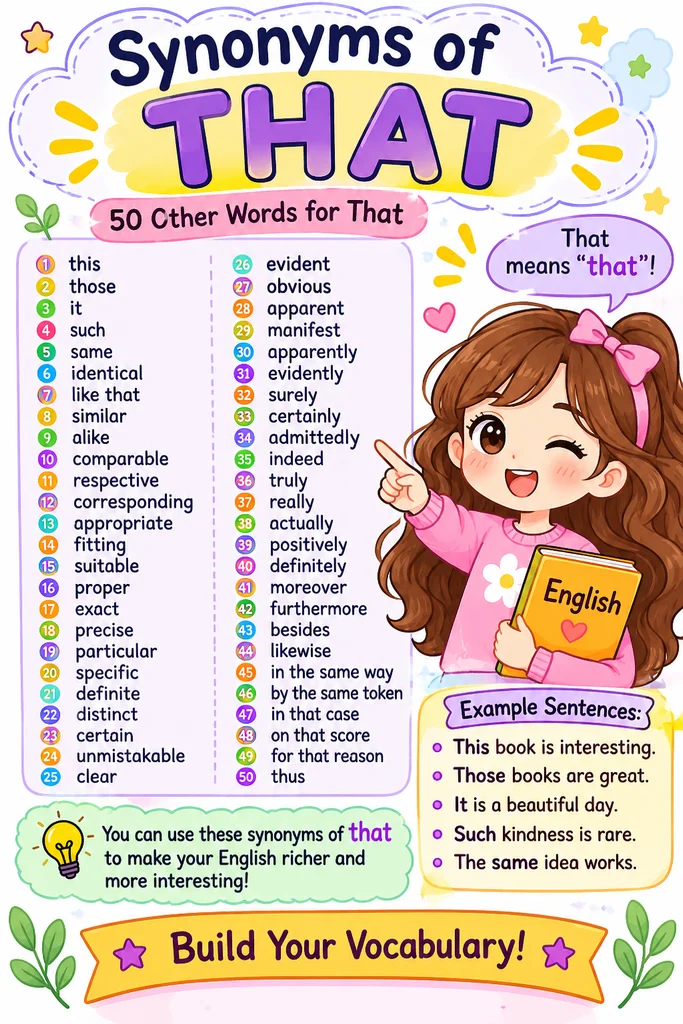
Synonyms of that depend on how the word is used in a sentence. Common alternatives and related expressions include which, who, whom, such, those, the one, and the thing, but not all of them can directly replace that.
Looking for other ways to say that without making your writing repetitive? The word that is used frequently in English, but finding the right alternative can sometimes be confusing. Whether you’re writing an essay, completing a school assignment, creating website content, or improving your English vocabulary, learning different ways to express the same idea can make your sentences clearer and more natural.
The word that has several grammatical uses, including as a pronoun, determiner, conjunction, and relative pronoun. Its alternatives depend on its role in a sentence. For example, which can sometimes replace that in relative clauses, while such can express a similar idea in certain contexts. In other sentences, changing or removing that may be more natural than replacing it with another word.
In this guide, you’ll discover useful synonyms of that, other words for that, and alternative expressions for different sentence structures. You’ll also explore their meanings, practical examples, grammar differences, and common usage mistakes to help you choose the right alternative. Whether you’re a student, writer, blogger, or English learner, this guide will help you use that more confidently and improve your everyday and professional writing.
This
Meaning: This points to a person or thing that is near you.
Examples:
- This is my favorite book.
- I want to buy this dress.
It
Meaning: It is used to talk about a thing, animal, or idea already known.
Examples:
- It looks like a great idea.
- I found it under the table.
Which
Meaning: Which is used to give more details about a thing or choice.
Examples:
- I bought a phone which has a good camera.
- She chose the dress which looked pretty.
Who
Meaning: Who is used to talk about a person.
Examples:
- I know the boy who won the race.
- She is the teacher who helped me.
Whom
Meaning: Whom is used when talking about a person who receives an action.
Examples:
- Whom did you invite to the party?
- The man whom I met was very kind.
Such
Meaning: Such is used to point to a person or thing of a certain kind.
Examples:
- I have never seen such a beautiful place.
- Such a kind person is hard to find.
Same
Meaning: Same means not different from something else.
Examples:
- We have the same school bag.
- I ordered the same pizza again.
These
Meaning: These points to two or more things that are near you.
Examples:
- These flowers smell lovely.
- I bought these shoes yesterday.
Those
Meaning: Those points to two or more things that are far away.
Examples:
- Those birds are flying high.
- I like those blue curtains.
The One
Meaning: The one refers to a person or thing already known.
Examples:
- The one I bought yesterday is broken.
- Please give me the one on the shelf.
The Thing
Meaning: The thing refers to an object, idea, or matter.
Examples:
- The thing I need most is your help.
- The thing you said made me smile.
The Person
Meaning: The person refers to a particular human being.
Examples:
- The person who called you is my uncle.
- The person I met was very friendly.
The Object
Meaning: The object refers to a particular physical thing.
Examples:
- The object you found belongs to me.
- The object on the desk is very old.
The Item
Meaning: The item refers to one particular thing in a group.
Examples:
- The item I ordered has arrived.
- Please check the item in the box.
The Fact
Meaning: The fact refers to something that is true or known.
Examples:
- The fact that she won made us happy.
- I cannot ignore the fact that he tried.
The Idea
Meaning: The idea refers to a thought or suggestion.
Examples:
- The idea that we should travel sounds fun.
- I like the idea of learning new skills.
The Reason
Meaning: The reason explains why something happens.
Examples:
- The reason I left was simple.
- Tell me the reason you are upset.
The Way
Meaning: The way refers to how something is done.
Examples:
- I like the way you speak.
- The way she solved the problem was smart.
The Place
Meaning: The place refers to a particular location.
Examples:
- The place we visited was beautiful.
- I remember the place where we first met.
The Time
Meaning: The time refers to a particular moment or period.
Examples:
- The time we spent together was special.
- I remember the time you helped me.
Because
Meaning: Because gives the reason why something happens.
Examples:
- I know that you are tired.
- I stayed home because I felt sick.
Since
Meaning: Since can give a reason for something.
Examples:
- Since you are here, let’s start.
- Since it was raining, we stayed inside.
As
Meaning: As can explain why something happens.
Examples:
- As it was late, we went home.
- I smiled as I saw my friend.
For
Meaning: For can introduce a reason or explanation in some sentences.
Examples:
- I stayed quiet, for I had nothing to say.
- She was happy, for her family had arrived.
So
Meaning: So shows the result of an action or situation.
Examples:
- I was hungry, so I made a sandwich.
- It was cold, so we closed the window.
In Order That
Meaning: In order that explains the purpose of an action.
Examples:
- I spoke slowly in order that everyone could understand.
- She saved money in order that she could buy a laptop.
So That
Meaning: So that explains why someone does something.
Examples:
- I wrote it down so that I would not forget.
- He left early so that he could catch the bus.
Provided That
Meaning: Provided that means something will happen only if a condition is met.
Examples:
- You can go out provided that you finish your work.
- I will help you provided that you ask politely.
On Condition That
Meaning: On condition that means something is allowed only if a rule is followed.
Examples:
- You can borrow my car on condition that you drive safely.
- She agreed on condition that everyone would help.
Assuming That
Meaning: Assuming that means thinking something is true for now.
Examples:
- Assuming that it does not rain, we will play outside.
- Assuming that he agrees, we can begin tomorrow.
Given That
Meaning: Given that introduces a fact that helps explain a situation.
Examples:
- Given that she is new, she did a great job.
- Given that it is late, we should leave.
Considering That
Meaning: Considering that means taking a fact into account.
Examples:
- Considering that he is young, he is very smart.
- Considering that it was a hard test, I did well.
Seeing That
Meaning: Seeing that gives a reason for something.
Examples:
- Seeing that you are busy, I will call later.
- Seeing that it was dark, we went inside.
Now That
Meaning: Now that explains a new situation or change.
Examples:
- Now that school is over, I can relax.
- Now that you are home, let’s eat.
In That
Meaning: In that explains the way something is different or special.
Examples:
- The two plans differ in that one costs more.
- She is lucky in that she has a loving family.
To the Extent That
Meaning: To the extent that shows how much something is true.
Examples:
- I agree to the extent that the plan is safe.
- The rule applies to the extent that it is fair.
The Above
Meaning: The above refers to something already mentioned.
Examples:
- Please read the above before you sign.
- The above points explain the main idea.
The Aforementioned
Meaning: The aforementioned refers to something mentioned earlier.
Examples:
- The aforementioned rule applies to all students.
- Please bring the aforementioned documents.
The Previously Mentioned
Meaning: The previously mentioned refers to something discussed before.
Examples:
- The previously mentioned book is now available.
- Please follow the previously mentioned steps.
The Foregoing
Meaning: The foregoing refers to information stated earlier.
Examples:
- The foregoing points explain the issue.
- The foregoing details are important for the report.
The Particular
Meaning: The particular refers to one specific person or thing.
Examples:
- The particular dress I wanted was sold out.
- I remember the particular day very well.
The Specific
Meaning: The specific refers to something exact or clearly identified.
Examples:
- The specific reason for his visit is unknown.
- Please tell me the specific date of the event.
The Exact
Meaning: The exact refers to something completely correct or precise.
Examples:
- I remember the exact words she used.
- Please write the exact address here.
The Selected
Meaning: The selected refers to something chosen from a group.
Examples:
- The selected answer is correct.
- Please check the selected file.
The Chosen
Meaning: The chosen refers to a person or thing picked by someone.
Examples:
- The chosen winner will receive a prize.
- I like the chosen design.
Such a Thing
Meaning: Such a thing refers to something of a particular kind.
Examples:
- I have never heard such a thing before.
- Such a thing should not happen again.
That Which
Meaning: That which refers to the thing or things that meet a condition.
Examples:
- Choose that which makes you happy.
- I will keep that which is useful.
Whatever
Meaning: Whatever refers to anything that someone chooses or needs.
Examples:
- Take whatever you need.
- Whatever you decide, I will support you.
Whichever
Meaning: Whichever refers to any one choice from a group.
Examples:
- Choose whichever color you like.
- You can take whichever book you want.
What
Meaning: What can refer to the thing or information being discussed.
Examples:
- I understand what you mean.
- What you said made me happy.
FAQS
1. What are the best synonyms of that?
Some useful alternatives are this, it, which, such, same, and those. The best choice depends on the meaning and sentence.
2. Can I use this instead of that?
Yes, sometimes. This usually points to something near you, while that often points to something farther away.
3. Is which a synonym of that?
Which can replace that in some relative clauses. However, both words follow different grammar rules in many sentences.
4. Why should I learn synonyms of that?
Learning alternatives helps you avoid repeated words, improve your vocabulary, and make your writing clearer.
5. How can I use synonyms of that in daily English?
Practice using these words in emails, text messages, school essays, and everyday conversations. Choose words that fit the meaning of your sentence.
Conclusion
Learning synonyms of that can make your English better and easier to understand. These words help you improve your writing, blogging, speaking, and daily communication. You do not need to learn all 50 words at once. Start with a few simple alternatives and use them in your emails, essays, and daily conversations. Keep practicing, and your English will become clearer and more natural.

Nora Collins writes stories about the secrets we keep, the choices that define us, and the connections that change our lives. With emotionally layered characters and an atmospheric style, she turns ordinary moments into unforgettable journeys of courage, discovery, and quiet transformation.
Pingback: 150+ Synonyms for Using: Better Words for Every Context