
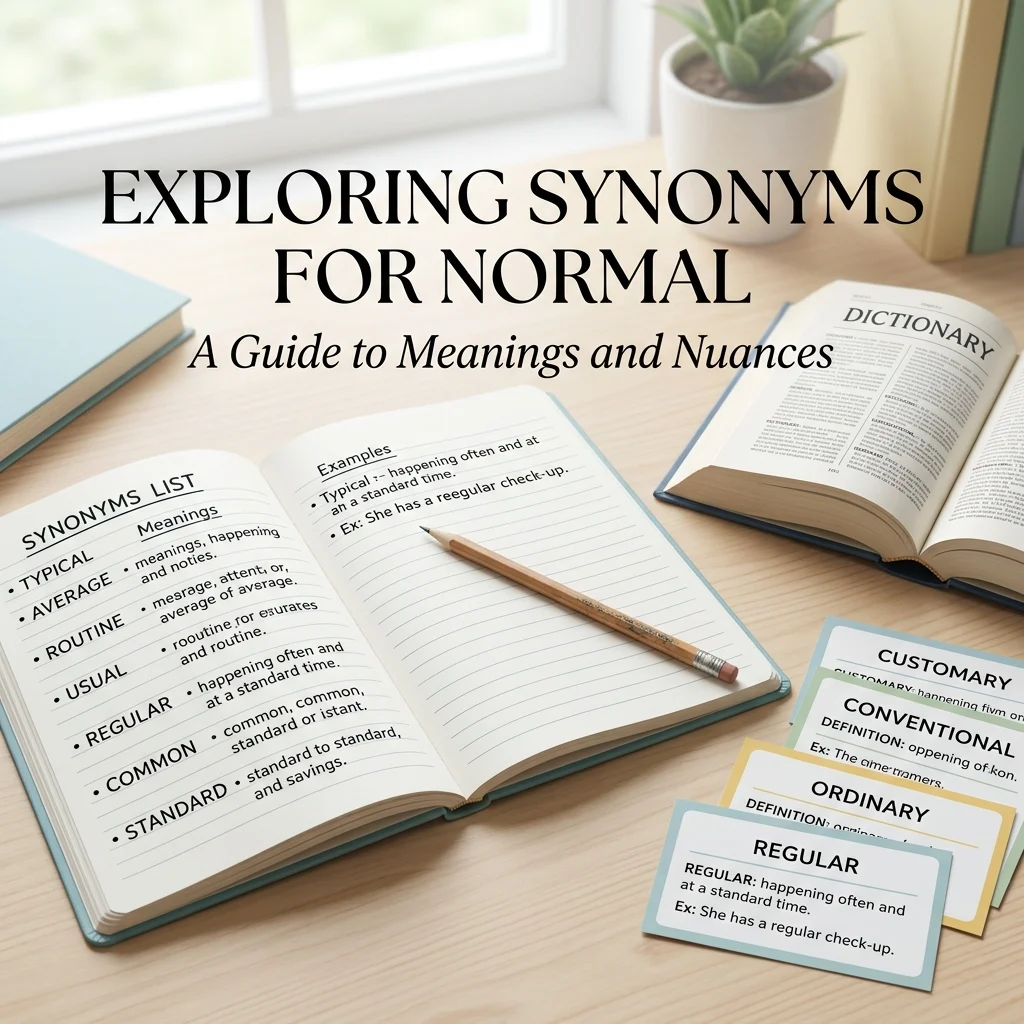
Synonyms for normal include usual, ordinary, typical, common, regular, standard, conventional, routine, and average. The best alternative depends on the sentence and the meaning you want to express.
Need a better word than normal? Choosing the right synonym can make your writing more precise and help you express exactly what you mean. Whether you’re writing an essay, creating content, or improving your English vocabulary, finding the right alternative helps you avoid repetition and make every sentence sound natural.
The word normal has several meanings. It can describe something usual, expected, ordinary, or typical in a particular situation. However, its synonyms are not always interchangeable. For example, usual describes something that happens regularly, while typical refers to something that represents common characteristics. Ordinary describes something that is not unusual or special, whereas standard often refers to an accepted level, rule, or requirement. Understanding these differences helps you choose the most accurate word for your sentence.
The best synonym for normal also depends on the context. In everyday conversation, usual, regular, and common are often natural choices. In formal writing, conventional may describe an established practice, while standard can refer to an accepted measure or level. For example, “It’s normal to feel nervous before an exam” can be rewritten as “It’s common to feel nervous before an exam.” However, “normal temperature” may require a more specific alternative depending on the temperature being discussed.
In this guide, you’ll discover the best synonyms for normal, including simple alternatives, formal and academic words, context-specific replacements, and practical example sentences. You’ll also learn how these words differ and which alternatives work best in different situations. Whether you’re a student, writer, blogger, or English learner, this guide will help you choose the right word confidently and make your writing clearer, more natural, and more precise.
Usual
Meaning: Usual means something that happens or is done most of the time.
Examples:
- I took my usual seat near the window.
- We eat dinner at our usual time.
Ordinary
Meaning: Ordinary means something that is not special or different.
Examples:
- It was an ordinary day at school.
- She wore an ordinary white shirt.
Regular
Meaning: Regular means something that happens often or follows a set plan.
Examples:
- He visits the gym on a regular basis.
- Our regular bus arrived late today.
Typical
Meaning: Typical means something that is common for a person, place, or thing.
Examples:
- Rainy mornings are typical here.
- That is a typical answer from my little brother.
Common
Meaning: Common means something that many people know, have, or do.
Examples:
- Colds are common during winter.
- This is a common mistake among new writers.
Standard
Meaning: Standard means something that follows an accepted rule or level.
Examples:
- The hotel offers standard rooms.
- Please use the standard form to apply.
Everyday
Meaning: Everyday means something that is used or seen each day.
Examples:
- These are my everyday shoes.
- Reading is part of her everyday routine.
Routine
Meaning: Routine means something that is done in the same way often.
Examples:
- My morning routine starts with a glass of water.
- The doctor performed a routine check.
Conventional
Meaning: Conventional means following common ways or accepted ideas.
Examples:
- They chose a conventional wedding dress.
- My teacher prefers conventional teaching methods.
Customary
Meaning: Customary means something that people usually do.
Examples:
- It is customary to greet guests warmly.
- A small gift is customary at the event.
Familiar
Meaning: Familiar means something you know well because you have seen it before.
Examples:
- Her voice sounded familiar to me.
- We walked down a familiar street.
Natural
Meaning: Natural means something that happens without being forced or unusual.
Examples:
- It is natural to feel nervous before a test.
- His smile looked natural in the photo.
Expected
Meaning: Expected means something that people think will happen.
Examples:
- The expected rain arrived in the evening.
- Her result was close to the expected score.
Average
Meaning: Average means something that is around the usual level.
Examples:
- The class scored an average of 75 points.
- This restaurant serves an average lunch.
Plain
Meaning: Plain means simple and without anything special added.
Examples:
- He chose a plain black notebook.
- I prefer plain rice with vegetables.
Simple
Meaning: Simple means easy to understand or not complicated.
Examples:
- She gave a simple answer to the question.
- We made a simple plan for the weekend.
Unremarkable
Meaning: Unremarkable means something that is not unusual or special.
Examples:
- The trip was pleasant but unremarkable.
- He had an unremarkable day at work.
Commonplace
Meaning: Commonplace means something that happens often and is not surprising.
Examples:
- Online shopping is commonplace today.
- Small delays are commonplace during busy hours.
Run-of-the-mill
Meaning: Run-of-the-mill means ordinary and not very special.
Examples:
- We watched a run-of-the-mill action movie.
- The shop sells run-of-the-mill office supplies.
Mainstream
Meaning: Mainstream means accepted or followed by most people.
Examples:
- Pop music is part of mainstream culture.
- The brand follows mainstream fashion trends.
Habitual
Meaning: Habitual means something that a person does often out of habit.
Examples:
- His habitual late arrival annoyed the team.
- She gave her habitual smile when she saw us.
Usual-looking
Meaning: Usual-looking means looking much like what people commonly expect.
Examples:
- He wore a usual-looking jacket to the meeting.
- The house had a usual-looking front door.
Expectedly
Meaning: Expectedly means in a way that people thought would happen, though “as expected” is often more natural.
Examples:
- As expected, the shop was busy on Sunday.
- The team won, just as expected by its fans.
Accepted
Meaning: Accepted means approved or treated as right by a group of people.
Examples:
- This is the accepted way to write the date.
- Her idea became an accepted practice at work.
Established
Meaning: Established means known or used for a long time.
Examples:
- The school follows an established set of rules.
- We used an established method to test the results.
Conventional-looking
Meaning: Conventional-looking means having an appearance that people commonly expect.
Examples:
- He wore a conventional-looking suit to the interview.
- The building has a conventional-looking design.
Unexceptional
Meaning: Unexceptional means not unusual or better than what is common.
Examples:
- The meal was tasty but unexceptional.
- She received an unexceptional score on the quiz.
Typical-looking
Meaning: Typical-looking means looking like what is common for a group or type.
Examples:
- It was a typical-looking village house.
- He carried a typical-looking school backpack.
Standardized
Meaning: Standardized means made the same by following set rules.
Examples:
- The school uses a standardized test.
- All branches follow a standardized process.
Predictable
Meaning: Predictable means something that happens in a way you can guess.
Examples:
- The ending of the film was predictable.
- His predictable jokes made everyone laugh.
Mundane
Meaning: Mundane means ordinary and often not very exciting.
Examples:
- Washing dishes is a mundane task.
- She spent the morning doing mundane office work.
Prosaic
Meaning: Prosaic means ordinary and lacking excitement or imagination.
Examples:
- His speech was clear but prosaic.
- They chose a prosaic name for their new shop.
Unpretentious
Meaning: Unpretentious means simple and not trying to seem more important than you are.
Examples:
- We enjoyed an unpretentious meal at a small cafe.
- Her unpretentious home felt warm and welcoming.
Unassuming
Meaning: Unassuming means quiet and simple without trying to attract attention.
Examples:
- The unassuming man helped everyone at the event.
- They stayed in an unassuming little hotel.
Run-of-the-day
Meaning: Run-of-the-day is not a common synonym for normal; “ordinary” or “routine” is usually a better choice.
Examples:
- The office handled its routine tasks before lunch.
- It was an ordinary day with no big surprises.
Everyday-type
Meaning: Everyday-type describes something that is common in daily life, though “everyday” is more natural.
Examples:
- She writes about everyday problems in her blog.
- We bought everyday items at the local store.
Standard-issue
Meaning: Standard-issue means supplied in the usual form by an organization.
Examples:
- Every worker received a standard-issue uniform.
- The new students got standard-issue school bags.
Conventional-minded
Meaning: Conventional-minded describes someone who prefers common ideas and traditional ways.
Examples:
- My conventional-minded uncle likes old family customs.
- The conventional-minded manager avoided risky changes.
Typical-case
Meaning: Typical-case describes a situation that is common or expected, though “typical example” is more natural.
Examples:
- This is a typical example of a spelling mistake.
- The teacher showed a typical case of poor planning.
Unadorned
Meaning: Unadorned means plain and without extra decoration.
Examples:
- The room had unadorned white walls.
- She chose an unadorned silver ring.
Unvaried
Meaning: Unvaried means staying the same without much change.
Examples:
- His unvaried diet needed more fresh foods.
- The class followed an unvaried daily schedule.
Unchanged
Meaning: Unchanged means staying the same as before.
Examples:
- The price remained unchanged all week.
- Her opinion about the book was unchanged.
Stable
Meaning: Stable means steady and not likely to change suddenly.
Examples:
- The internet connection is stable now.
- The patient was in stable condition after the check.
Typical of
Meaning: Typical of describes something that is common for a person or group.
Examples:
- Being helpful is typical of my best friend.
- This weather is typical of early spring.
Familiar-looking
Meaning: Familiar-looking means appearing like something you have seen before.
Examples:
- The logo looked familiar-looking at first glance.
- We passed a familiar-looking building on our walk.
Expected norm
Meaning: Expected norm means a behavior or condition that people generally consider usual.
Examples:
- Arriving on time is the expected norm at this office.
- The rules explain the expected norm for classroom behavior.
Accepted norm
Meaning: Accepted norm means a common rule or behavior that a group agrees to follow.
Examples:
- Saying thank you is an accepted norm in many settings.
- The team follows the accepted norm of sharing updates.
Standard practice
Meaning: Standard practice means a way of doing something that is commonly followed.
Examples:
- Saving a copy is standard practice in our office.
- Washing your hands is standard practice before cooking.
Business as usual
Meaning: Business as usual means life or work continues in its normal way.
Examples:
- After the short power cut, it was business as usual.
- The store reopened, and it was business as usual.
Status quo
Meaning: Status quo means the way things are at the present time.
Examples:
- The team decided to keep the status quo for now.
- She wanted to change the status quo at school.
FAQS
1. What is the simplest synonym for normal?
Usual is one of the simplest synonyms for normal. Both words describe something that happens often or is expected.
2. What are five common synonyms for normal?
Five common synonyms are usual, ordinary, regular, typical, and common. These words work well in everyday English.
3. Can I use normal and ordinary in the same sentence?
Yes, both words can describe something that is not special. For example, you can say, “It was a normal day” or “It was an ordinary day.”
4. Why should I learn synonyms for normal?
Learning synonyms helps you avoid repeating the same word. It can also make your writing clearer and more interesting.
5. Which synonym for normal is best for formal writing?
Standard, typical, and conventional can work well in formal writing. Choose the word that best matches the meaning of your sentence.
Conclusion
Learning synonyms for normal can help you improve your writing, blogging, speaking, and daily communication. Words such as usual, ordinary, regular, and typical can make your sentences clearer and more interesting. However, not every synonym fits every situation, so always check the meaning before using a new word. Practice these alternatives in your emails, essays, blog posts, and daily conversations. The more you use them, the more confident you will become in English.

Ethan Caldwell writes at the edge of mystery and human nature, where every secret has a consequence. His atmospheric stories explore obsession, identity, and the choices that haunt us, creating unforgettable characters and narratives that linger long after the final page.
Pingback: 79+ Synonyms for Eager: Best Words to Use