
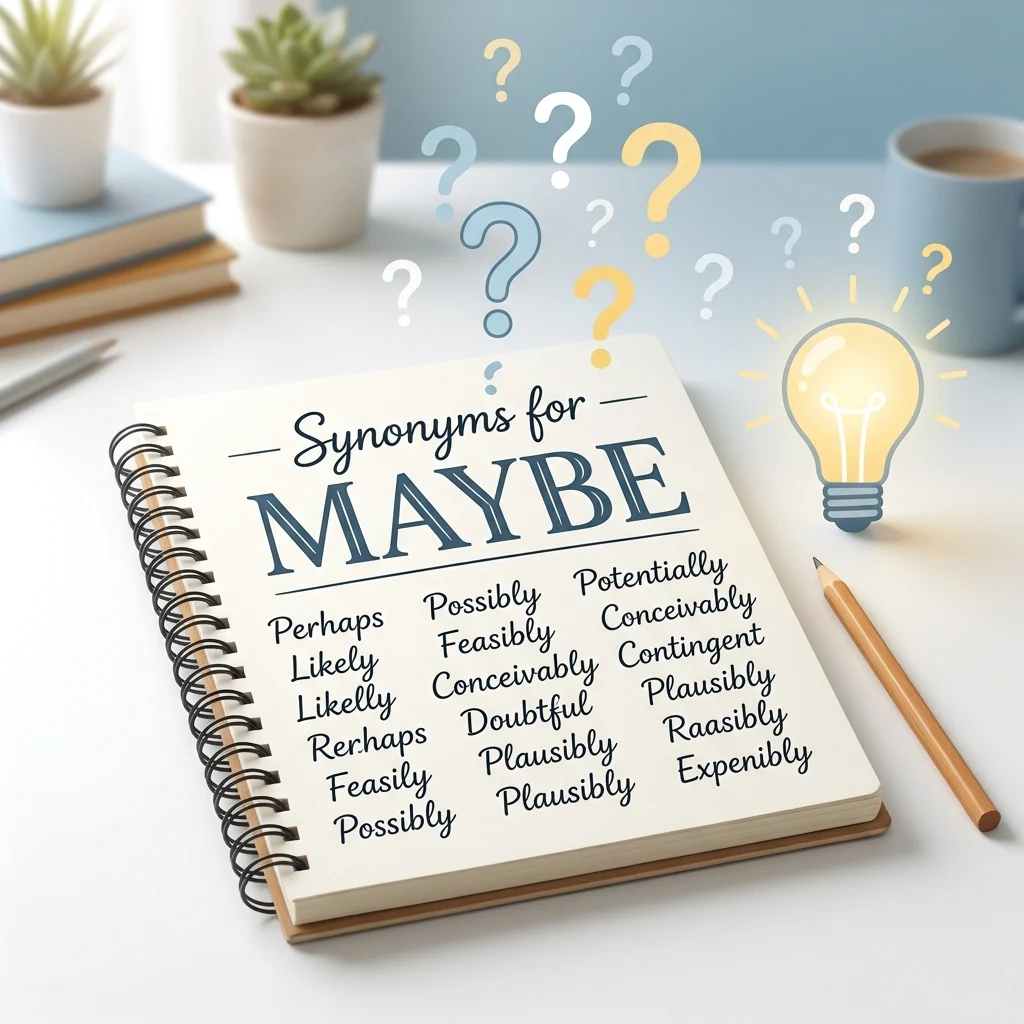
Synonyms for maybe include perhaps, possibly, conceivably, and it is possible that. These alternatives express uncertainty or possibility, while words like probably suggest a greater likelihood.
Choosing the right word for uncertainty can make the difference between a vague sentence and a clear, natural message. If you find yourself using maybe repeatedly, exploring its synonyms can help you express possibilities more precisely. Whether you’re writing an essay, sending a professional email, or having a casual conversation, the best alternative depends on what you mean and how certain you want to sound.
The word maybe means that something is possible but not certain. However, its alternatives have slightly different meanings and uses. For example, perhaps is a versatile replacement that works in everyday and formal writing. Possibly emphasizes that something could happen or be true, while conceivably describes something that is imaginable or theoretically possible. Consider this example: “Maybe we can meet tomorrow” can become “Perhaps we can meet tomorrow” without significantly changing the meaning.
Some alternatives require more care. Potentially often describes something that could happen or produce a particular result, while probably suggests that something is more likely to happen than not. Therefore, these words are not always interchangeable. Understanding their differences helps you choose a synonym that matches your intended meaning instead of accidentally making your statement sound more certain.
In this guide, you’ll discover the best synonyms for maybe, including common alternatives, formal and informal expressions, academic options, and useful phrases for different situations. You’ll also find practical example sentences and explanations of when each alternative works best. Whether you’re a student, writer, blogger, or English learner, this guide will help you expand your vocabulary, avoid repetitive wording, and express uncertainty with greater accuracy and confidence.
Perhaps
Meaning: Perhaps means something may happen, but you are not sure.
Examples:
- Perhaps we will visit Grandma tomorrow.
- Perhaps he is still at school.
Possibly
Meaning: Possibly means something can happen or be true.
Examples:
- We could possibly finish the game today.
- She will possibly join us for lunch.
Probably
Meaning: Probably means something is likely to happen.
Examples:
- It will probably rain this evening.
- Dad will probably come home soon.
Likely
Meaning: Likely means something has a good chance of happening.
Examples:
- Our team is likely to win today.
- She is likely to arrive before noon.
Conceivably
Meaning: Conceivably means something could happen, even if it seems unlikely.
Examples:
- Conceivably, we could finish the project early.
- He could conceivably become a great singer.
Potentially
Meaning: Potentially means something may happen in the future.
Examples:
- This idea could potentially save us time.
- The new road could potentially help many people.
Perchance
Meaning: Perchance is an old-fashioned way to say perhaps.
Examples:
- Perchance, we shall meet again.
- Perchance she will visit us one day.
It May Be
Meaning: It may be means something could be true.
Examples:
- It may be the right answer.
- It may be too late to call him.
It Could Be
Meaning: It could be means something is possible but not certain.
Examples:
- It could be my missing book.
- It could be a good day for a picnic.
There Is a Chance
Meaning: There is a chance means something may happen.
Examples:
- There is a chance we will get tickets.
- There is a chance she will call tonight.
In All Likelihood
Meaning: In all likelihood means something will probably happen.
Examples:
- In all likelihood, the shop will open soon.
- In all likelihood, they will accept our offer.
By Any Chance
Meaning: By any chance is used to ask if something might be true or possible.
Examples:
- Do you have a pen by any chance?
- Could you help me by any chance?
As It May Be
Meaning: As it may be suggests that something could be true, depending on the situation.
Examples:
- The answer, as it may be, is still unclear.
- This plan, as it may be, needs more work.
For All I Know
Meaning: For all I know means you do not know for sure what is true.
Examples:
- For all I know, he is already home.
- For all I know, they may have left early.
I Suppose
Meaning: I suppose means you think something may be true.
Examples:
- I suppose we can try again tomorrow.
- I suppose she is busy right now.
I Guess
Meaning: I guess means you think something is true but are not certain.
Examples:
- I guess we should leave now.
- I guess he forgot about the meeting.
Maybe So
Meaning: Maybe so means something might be true.
Examples:
- Maybe so, but we need more proof.
- Maybe so, and we can check later.
It Is Possible
Meaning: It is possible means something can happen or be true.
Examples:
- It is possible that we will win.
- It is possible to finish this task today.
It Is Likely
Meaning: It is likely means something will probably happen.
Examples:
- It is likely that school will close early.
- It is likely that he knows the answer.
It Is Uncertain
Meaning: It is uncertain means something is not known for sure.
Examples:
- It is uncertain whether the bus will arrive on time.
- It is uncertain if we can go camping.
Not Impossible
Meaning: Not impossible means something could happen.
Examples:
- It is not impossible for us to win.
- A quick fix is not impossible.
Could Be
Meaning: Could be means something may be true or may happen.
Examples:
- This could be the best way to learn.
- He could be waiting outside.
Might Be
Meaning: Might be means something is possible but not certain.
Examples:
- She might be at the library.
- That might be the answer we need.
May Happen
Meaning: May happen means something could take place.
Examples:
- A delay may happen because of the rain.
- Good things may happen when you keep trying.
Might Happen
Meaning: Might happen means something could take place, but you are unsure.
Examples:
- A power cut might happen tonight.
- We might happen to meet at the mall.
In Some Cases
Meaning: In some cases means something is true in certain situations.
Examples:
- In some cases, a short break can help.
- In some cases, children learn better through play.
Under Certain Conditions
Meaning: Under certain conditions means something may happen if some rules or needs are met.
Examples:
- Under certain conditions, plants can grow indoors.
- Under certain conditions, we may change the plan.
If Possible
Meaning: If possible means something should happen if it can be done.
Examples:
- Please arrive early, if possible.
- We will meet outside, if possible.
Perhaps So
Meaning: Perhaps so means something may be true.
Examples:
- Perhaps so, but I would like to check.
- Perhaps so, and we will know soon.
It Seems Possible
Meaning: It seems possible means something looks as if it could happen.
Examples:
- It seems possible that we can finish today.
- It seems possible that she will agree.
There Is a Possibility
Meaning: There is a possibility means something may happen or be true.
Examples:
- There is a possibility of snow tomorrow.
- There is a possibility that our team will qualify.
One Never Knows
Meaning: One never knows means anything may happen because the future is uncertain.
Examples:
- One never knows; you may win the prize.
- One never knows what tomorrow will bring.
Who Knows?
Meaning: Who knows? means nobody can say for sure what will happen.
Examples:
- Who knows? We may find a better place.
- Who knows? He might change his mind.
It Is Not Certain
Meaning: It is not certain means something is still unknown.
Examples:
- It is not certain that the match will take place.
- It is not certain whether they will come.
Maybe Later
Meaning: Maybe later means something could happen at a later time.
Examples:
- I cannot play now, but maybe later.
- Maybe later, we can talk about the trip.
At Some Point
Meaning: At some point means something may happen at an unknown time.
Examples:
- We may visit that town at some point.
- At some point, you will need to make a choice.
In Time
Meaning: In time means something may happen before it is too late or at a suitable time.
Examples:
- We may reach the station in time.
- In time, he may learn to drive.
For Now, Perhaps
Meaning: For now, perhaps means something may be suitable at the present time.
Examples:
- For now, perhaps we should wait.
- For now, perhaps this small room will work.
I Would Say
Meaning: I would say means you are giving an opinion without being fully certain.
Examples:
- I would say the trip takes an hour.
- I would say she is around ten years old.
I Believe
Meaning: I believe means you think something is true.
Examples:
- I believe he will come to the party.
- I believe this answer is correct.
I Think So
Meaning: I think so means you believe something is true but may not be fully sure.
Examples:
- I think so, but let me check.
- I think so; the shop usually closes late.
It Could Happen
Meaning: It could happen means something is possible.
Examples:
- It could happen if we work together.
- A surprise visit could happen this weekend.
There Is a Possibility That
Meaning: There is a possibility that means something may be true or may happen.
Examples:
- There is a possibility that the train is delayed.
- There is a possibility that we will need more time.
In Theory
Meaning: In theory means something should be possible based on an idea or plan.
Examples:
- In theory, this plan should work.
- In theory, the trip takes two hours.
Potentially Speaking
Meaning: Potentially speaking means looking at what might happen.
Examples:
- Potentially speaking, this change could help everyone.
- Potentially speaking, the team could reach the final.
It Is Within the Realm of Possibility
Meaning: This phrase means something could happen, even if it is not certain.
Examples:
- It is within the realm of possibility that we will win.
- It is within the realm of possibility that the plan will succeed.
If Things Work Out
Meaning: If things work out means something may happen if everything goes well.
Examples:
- If things work out, we will move next month.
- If things work out, I will join your team.
With Any Luck
Meaning: With any luck means something good may happen if things go well.
Examples:
- With any luck, we will find a taxi soon.
- With any luck, the weather will stay sunny.
It Is Up in the Air
Meaning: It is up in the air means something has not been decided yet.
Examples:
- Our holiday plans are still up in the air.
- The date of the event is up in the air.
Time Will Tell
Meaning: Time will tell means we will know the truth in the future.
Examples:
- Time will tell if this idea works.
- Time will tell whether he keeps his promise.
Frequently Asked Questions
1. What are the best synonyms for maybe?
Some common synonyms for maybe are perhaps, possibly, could be, might be, and it is possible.
2. What is a simple word for maybe?
“Perhaps” is a simple and useful alternative to “maybe.” Both words show that something is possible but not certain.
3. Can I use perhaps instead of maybe?
Yes. You can use “perhaps” instead of “maybe” in most situations. For example, “Maybe she will come” can become “Perhaps she will come.”
4. What is a formal synonym for maybe?
“Possibly” and “perhaps” are useful alternatives in formal writing. “There is a possibility” also works well in reports and professional emails.
5. Why should I learn synonyms for maybe?
Learning synonyms helps you avoid using the same word too often. It can make your essays, blog posts, emails, and conversations clearer and more interesting.
Conclusion
Learning synonyms for maybe can help you improve your writing, blogging, speaking, and daily communication. Words like “perhaps,” “possibly,” and “might be” help you share ideas in different ways. Try using these words in your emails, essays, and everyday conversations. Start with a few words and practice them each day. With time, you will feel more confident and make your English sound more natural.

Clara Weston is a storyteller fascinated by the emotions that shape who we become. Her writing explores love, loss, identity, and the quiet choices that change everything, weaving deeply human characters into evocative stories that remain in the heart long after the last page.
Pingback: 167+ Synonyms for Happiness: Find the Perfect Word